

Cricket pitch measurements | Crease Lines & other pitch basics


Hi guys, Cricket Cordon again here. Today we will discuss that aspect of a cricket game that plays a major role in determining the outcome of the match. This is the ‘cricket pitch‘ and we’ll understand cricket pitch measurements and some other cricket pitch related basics too, like –
- 3 Types of Crease Lines
- Danger Zone
- Difference between Over and Around the Wicket
- and Wicket (bails/stumps) measurements
INTRODUCTION
As we saw in the field positions blog, a cricket pitch is a rectangular area in the center of a cricket field where the batter stands to face the bowler. During the game the bowler bowls from the non-striker’s end to the striker at the other end. However after each over the ends swap.
Cricket Pitch Measurements

The length of the pitch is measured from one set of the wickets to the other. It measures 22 yards in length and 10 feet in width.
3 Types of Crease Lines
There are four crease lines on both ends of the pitch:
1. Bowling Crease
- The bowling crease is the line through the centers of the three stumps at each end and it is 2.64 meter long.
- Historically part of the bowler’s back foot was required to fall behind the bowling crease to avoid a no-ball.
- The wicket keeper’s hands must also stay behind this line while collecting the ball to avoid a no-ball.
2. Popping Crease
- The popping crease is 4 feet in front of and parallel to the bowling crease at each end.
- Although it is considered to have unlimited length, it needs only be marked to at least 3.6 meters.
- To avoid a no-ball, some part of the bowler’s front foot in the delivery stride must be behind the popping crease when it lands, although it does not have to be rounded.
- Similarly some part of the batter’s body or bat must be behind this line to avoid a stump or run out.
3. Return Creases (2 on each end)
- Four return creases are drawn to on each side of the pitch.
- These laps are perpendicular to the bowling crease and the popping crease.
- Each return crease is considered to be unlimited in length and need only be marked to a minimum of 2.4 meter from the popping crease.
- To avoid a no-ball, the bowler’s back foot in the delivery stride must land within and not touch the return crease.
Protected Area/ Danger Zone

- The protected area or danger area is the central portion of the pitch, a rectangle 2 feet wide and beginning 5 feet from each popping crease.
- Under the laws of cricket, the bowler must avoid running on this area during their follow-through. If done so, the umpire issues the first warning to the bowler and the team captain.
- On the third warning, the umpire will eject the bowler from the attack and the bowler may not bowl again for the remainder of the innings.
Difference between OVER & AROUND the Wicket
- If a right hand bowler bowls from the left of the wicket, it is known as over the wicket. It does not matter whether the batter is right handed or left handed.
- And when the right hand bowler bowls from the right side of the wicket, it is known as around the wicket.
- Similarly, if the left hand bowler bowls from the right side of the wicket, it is known as over the wicket and round the wicket if he bowls from the left side.
Wicket (Stumps/ Bails) Measurements
Law Number 8 in the laws of cricket determines the dimensions and placement of a wicket.
Wicket Measurement
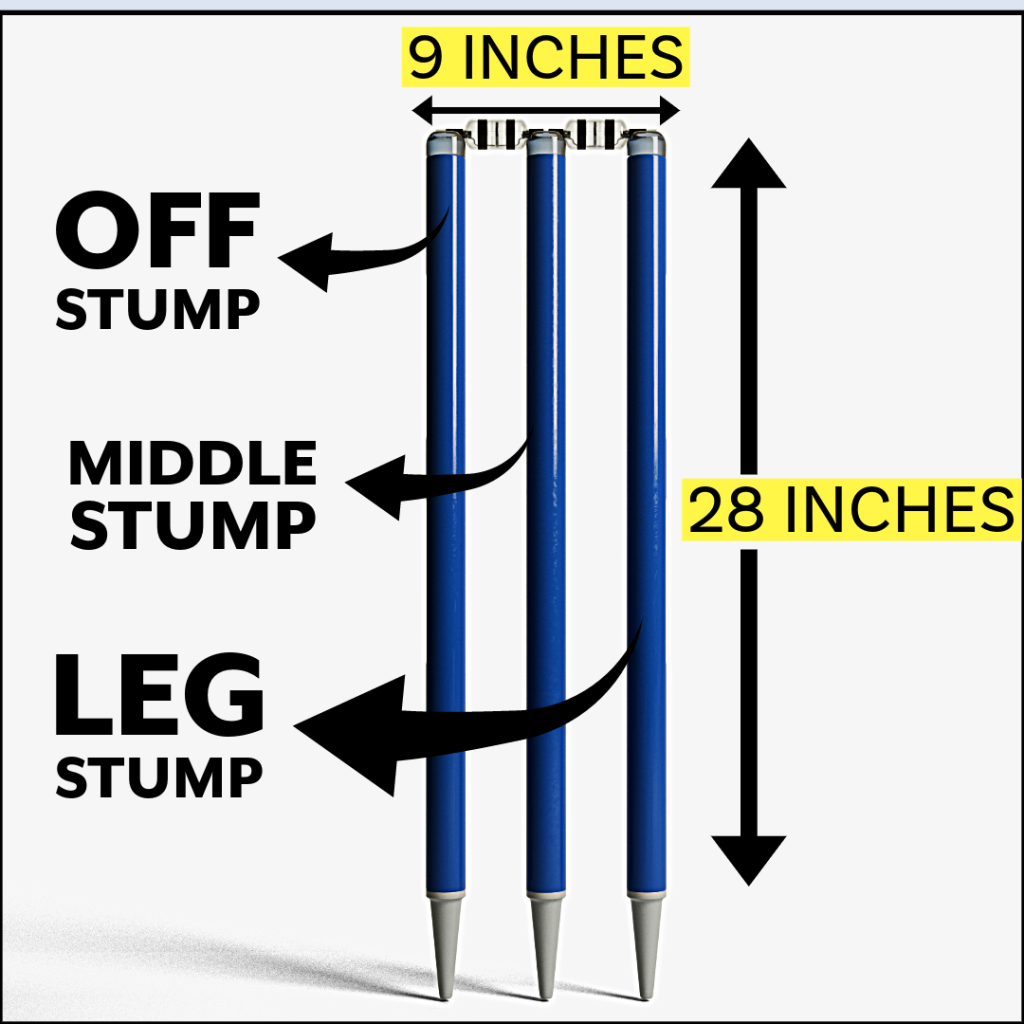
- A wicket comprises of 3 stumps and 2 bails at either end of the pitch. The stumps are 28 inches in height and 9 inches wide.
- They have a spike at one end for inserting into the ground and the other end has a U-shaped roof to provide a resting place for the bays.
- The stumps are placed along the batting crease with equal distances between each stump.
- Each stump has a specific name – Off stump on the off side of the wicket, middle stump is the center wicket and leg stump on the on or leg side of the wicket.
* These names are related to the batter so a right handed batter’s leg stump becomes the off stump for a left handed batter.
Bails Measurement
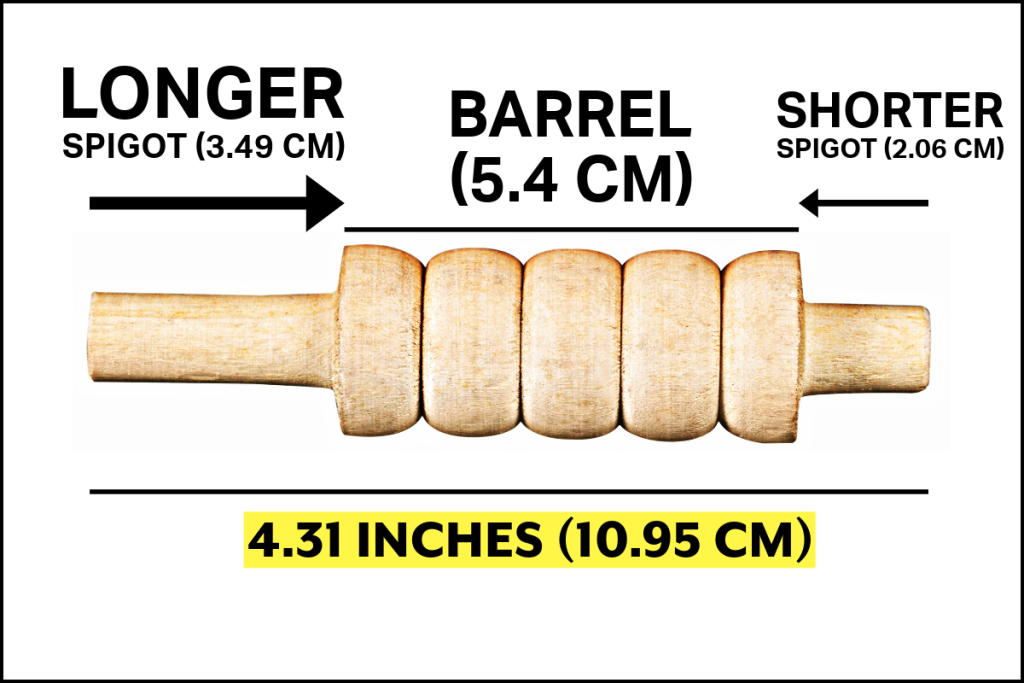
- Two wooden bails are placed in shallow grooves on top of the stumps.
- The bails must not project more than 0.5 inches above the stumps and must be 4.31 inches long.
- Each bail is made of a single cylindrically shaped piece of wood.
- The large central cylinder is called the barrel which is 5.4 cm in length while the smaller protrusions are the spigots. The longer spigot is 3.49 cm long whereas shorter spigot is 2.06 cm in length.
- The longer rests alone on one stump while the shorter rests on the middle stump together with the short spigot of the other bail.
If you want to learn all the fielding positions in cricket, then click here.